
Most properties don’t have a “sweeping problem,” they have a debris-capture problem.
A machine can make a parking lot look better for an hour while leaving the fine sediment, metal fragments, and curb-line buildup that cause complaints, clogged drains, and failed inspections. If you’re trying to choose (or evaluate) parking lot sweeping equipment, this guide breaks down what actually works in the field, what doesn’t, and how to tell the difference.
Effective sweeping equipment does three things consistently:
That third point is easy to overlook. Fine sediment is one of the most common stormwater pollutants, and dry cleanup methods like sweeping are widely used as a best practice to reduce runoff contamination. For background on stormwater programs and why sediment control matters, see the EPA overview of the NPDES stormwater program.
There’s no single “best sweeper.” The best setup depends on your debris mix, layout, and standards (curb lines, inlets, public edges, entrances).
What they’re good at:
Mechanical broom sweepers excel at heavier debris like gravel, leaves, sand, and construction grit. They use rotating brooms to scrub debris loose and move it onto a conveyor into a hopper.
Where they shine:
Common limitations:
What they’re good at:
Regenerative air units are often chosen for finer material because they circulate air to lift debris, then capture it. In the right conditions, they can do an excellent job on dust and light sediment.
Where they shine:
Common limitations:
What they’re good at:
Vacuum sweepers use suction to pull debris into the hopper. They are often associated with strong fine-particle capture when filtration and maintenance are kept up.
Where they shine:
Common limitations:
If your property includes parking garages, drive lanes, tight islands, or dense curb geometry, compact sweepers matter as much as the “big machine.” Large sweepers can miss the places that generate the most complaints.
Where they shine:
For garage-specific considerations, see: Parking Garage Cleaning: How to Cut Dust and Track-Out.
Some of the most effective “equipment choices” are not the main sweeper at all.
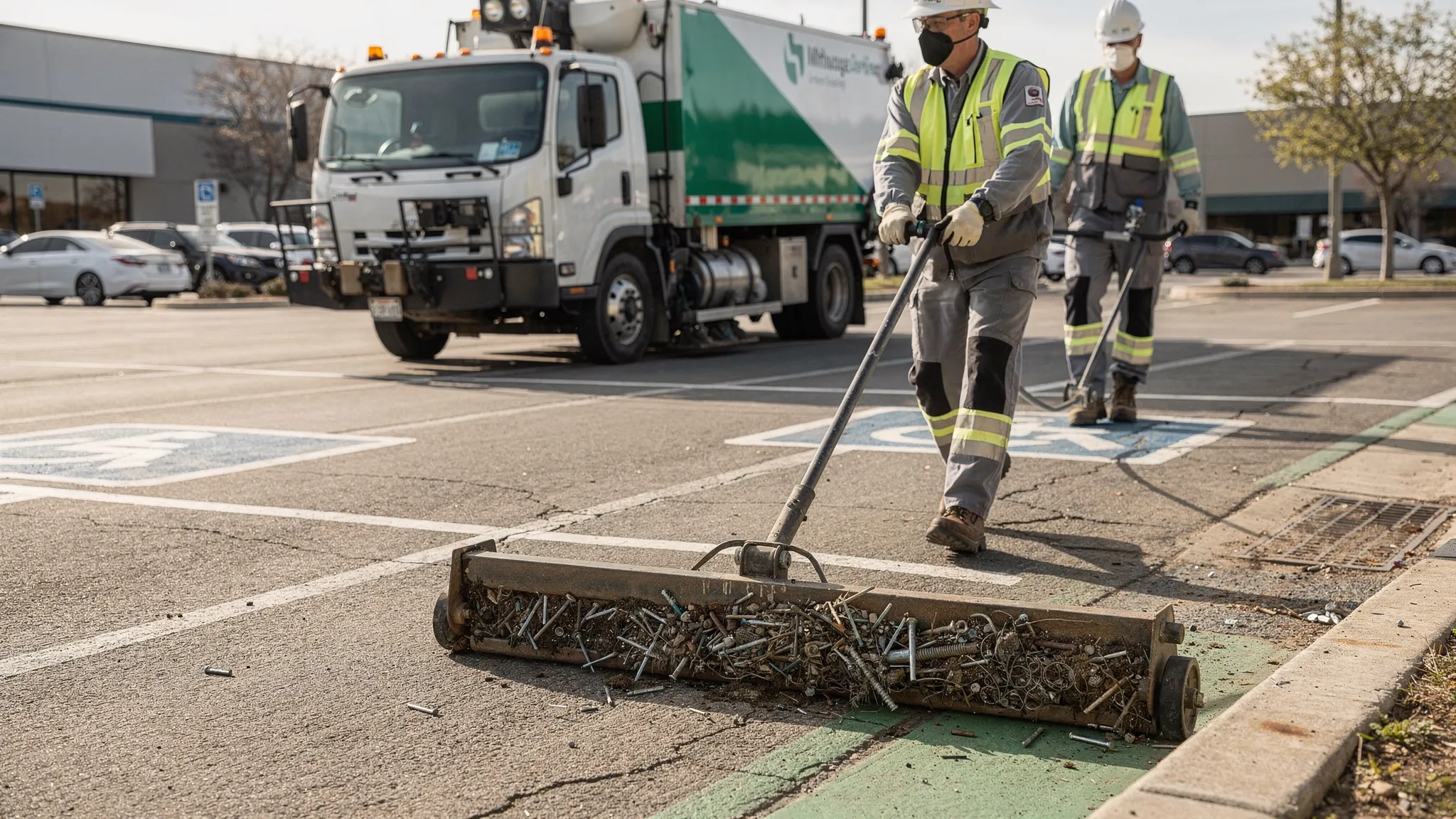
Magnet sweepers (for ferrous metal): If you have construction traffic, tire hazards, or repeated flats, a magnet pass can be the difference between “looks clean” and “is safe.”
Dust and mud control tools: Water application, targeted pre-wetting, and track-out controls often determine whether sweeping stays ahead of the mess.
Manual detail tools: Curb corners, around bollards, and at inlets often need a manual assist so debris is captured, not shoved into the next rain event.
If you want to select the right parking lot sweeping equipment, start by naming your debris mix.
What works: Mechanical broom sweepers are usually the most efficient for heavier and bulkier debris. The key is slowing down at edges and corners and treating curb lines as a priority zone.
What fails: Fast, open-area passes that leave windrows at curb lines, around islands, and at curb returns.
What works: Regenerative air or vacuum-style sweeping paired with good dust control, plus a process that includes edge work first or last (so the lot doesn’t look clean while the curb line still holds the problem).
Nashville and Middle Tennessee spring pollen can overwhelm “pretty passes” quickly, so your program usually needs a baseline cadence plus seasonal boosts. Related: Parking Lot Sweeping Nashville: A Seasonal Schedule That Works.
What fails: Blowing dust off sidewalks or islands into the lot, or rinsing fines toward inlets without recovery. It looks productive and backfires later.
Mud is a different animal. Once it cakes, sweeping gets harder and takes longer.
What works: A two-step approach.
If the site keeps producing mud, the “equipment fix” is incomplete without track-out controls and trigger-based responses. Related: Nashville Environmental Cleaning: Stormwater-Friendly Cleanup Basics.
What fails: Waiting until mud dries into a hard layer, then trying to sweep it like normal dust.
If you manage construction-adjacent properties, industrial yards, or paving projects, assume metal is present unless proven otherwise.
What works: Magnet sweeping after sweeping, not before. Sweepers move and expose metal, magnets capture what’s left behind.
What fails: Relying on visual checks alone. Nails hide in grooves, joints, and texture, and the first “inspection” is usually a tenant’s tire.
What works: Mechanical broom sweeping with deliberate curb-line work, plus debris removal where piles form. Paving debris tends to be heavier, sharp, and concentrated.
What fails: Treating it like normal retail litter, or skipping edge resets and transitions where aggregate collects.
When a vendor says “we run top equipment,” ask what’s configured for your outcome. These are the features that typically decide whether a lot stays clean between visits.
Ask how dust is controlled during dry conditions and what maintenance practices keep capture performance consistent. A great sweeper operated dry and fast can still leave a dust haze and fine trails.
Most complaints come from edges: curb lines, corners, curb returns, dumpster pads, and drain approaches.
If the sweeper is not set up for curb work (and the operator is not expected to do it), your site will never look consistently maintained.
A big sweeper that cannot reach the trouble spots is the wrong tool by definition.
The best programs match equipment to zones, using a compact unit (or a detail process) for:
Capture is only half the story. If the hopper fills early and dumping is far away, the operator will be pressured to rush or cut corners.
For debris-heavy sites, the question is simple: Where does the material go, and how often is it dumped?
Two identical sweepers can produce wildly different results. The “feature” that matters most is the operator’s sequence and standard.
If you want a practical sequence that reduces rework (especially when wet cleaning is involved), see: Cleaning and Sweeping: The Best Order for Faster Turnovers.
Instead of judging by “it looks better,” use simple pass or fail checks tied to the zones that create risk.
Walk only the edges and water pathways:
If those areas are not improving, the equipment, the process, or the scope is wrong.
For professional services, ask for lightweight proof:
If you’re deciding whether to run sweeping in-house, the biggest mistakes are:
A full cost comparison is site-specific, but this framework helps: The Sweeping Company vs In-House: Which Costs Less?.
If you only ask “what sweeper do you use,” you’ll get a brand and a model, not an outcome.
Ask these instead:
If you want a broader vendor-evaluation checklist, this related guide is useful: Street Sweeping Companies: 8 Things to Compare First.
What is the best parking lot sweeping equipment for commercial properties? The best parking lot sweeping equipment depends on your debris. Mechanical broom sweepers often excel with heavier grit and leaves, while regenerative air or vacuum sweepers can perform well for fine dust when curb-line detail and dust control are included.
Do parking lot sweepers remove mud track-out? They can, but mud often requires a two-step approach: bulk removal first, then sweeping focused on exits, turns, and curb lines. If mud keeps returning, track-out controls and trigger sweeps matter as much as the machine.
When is magnet sweeping necessary? Magnet sweeping is most valuable when there’s a risk of nails, screws, and other ferrous metal, especially near construction activity, industrial loading areas, or after paving and contractor work.
Why do lots look clean in the middle but dirty at the edges after sweeping? That usually means the scope or process is focused on open-area passes and not on curb-line detail zones. Edges collect sediment and litter, and they require slower, deliberate work and the right equipment setup.
Is sweeping better than pressure washing for parking lots? For most routine maintenance, sweeping is the right first step because it captures dry debris and sediment. Pressure washing can help for stains, gum, or buildup, but it should be targeted and done with wash-water controls. Related: Pavement Cleaning: When Power Washing Isn’t Enough.
Reliable Sweepers provides professional sweeping and property maintenance across Middle Tennessee, including parking lot and garage sweeping, construction site cleanup, magnet sweeping, dust and mud control, and emergency response.
If you want a practical plan based on your site’s debris and “hot zones,” contact Reliable Sweepers to discuss scope and scheduling options: https://www.reliablesweepers.com.
