
Construction cleanup around Nashville is becoming less of a final-day task and more of an ongoing operational need. As development pushes into suburban corridors, commercial centers, industrial parks, and fast-growing residential areas, the mess is showing up earlier and in more visible places: curb lines, storm drains, turn lanes, sidewalks, parking lots, and neighborhood entrances.
For contractors, property managers, HOAs, and facility teams, the takeaway is simple. If your site sits in one of the growing areas around Nashville TN, cleanup planning needs to start before mud, dust, and debris become a complaint, inspection issue, or schedule delay.
Downtown Nashville still creates plenty of cleanup demand, especially around infill projects, nightlife corridors, hotel work, mixed-use buildings, and tight curb access. But construction cleanup is no longer concentrated in the urban core. Growth across Middle Tennessee has pushed heavy equipment, delivery routes, paving activity, and utility work into communities that were not dealing with the same volume of construction traffic a decade ago.
That changes the cleanup equation. A site on a quiet suburban road can become a daily track-out source when dump trucks and concrete deliveries start moving. A retail center near a road widening project can collect dust and loose aggregate before customers even know where it came from. A neighborhood entrance near homebuilding can look neglected after one rain event if sediment reaches the curb line.
Middle Tennessee conditions make this more noticeable. Clay soil sticks to tires, spring storms move sediment quickly, summer dryness turns fine material into dust, and fall leaf drop can hide debris until drains start backing up. Cleanup is not just about appearance. It supports access, safety, stormwater housekeeping, and the pace of closeout.
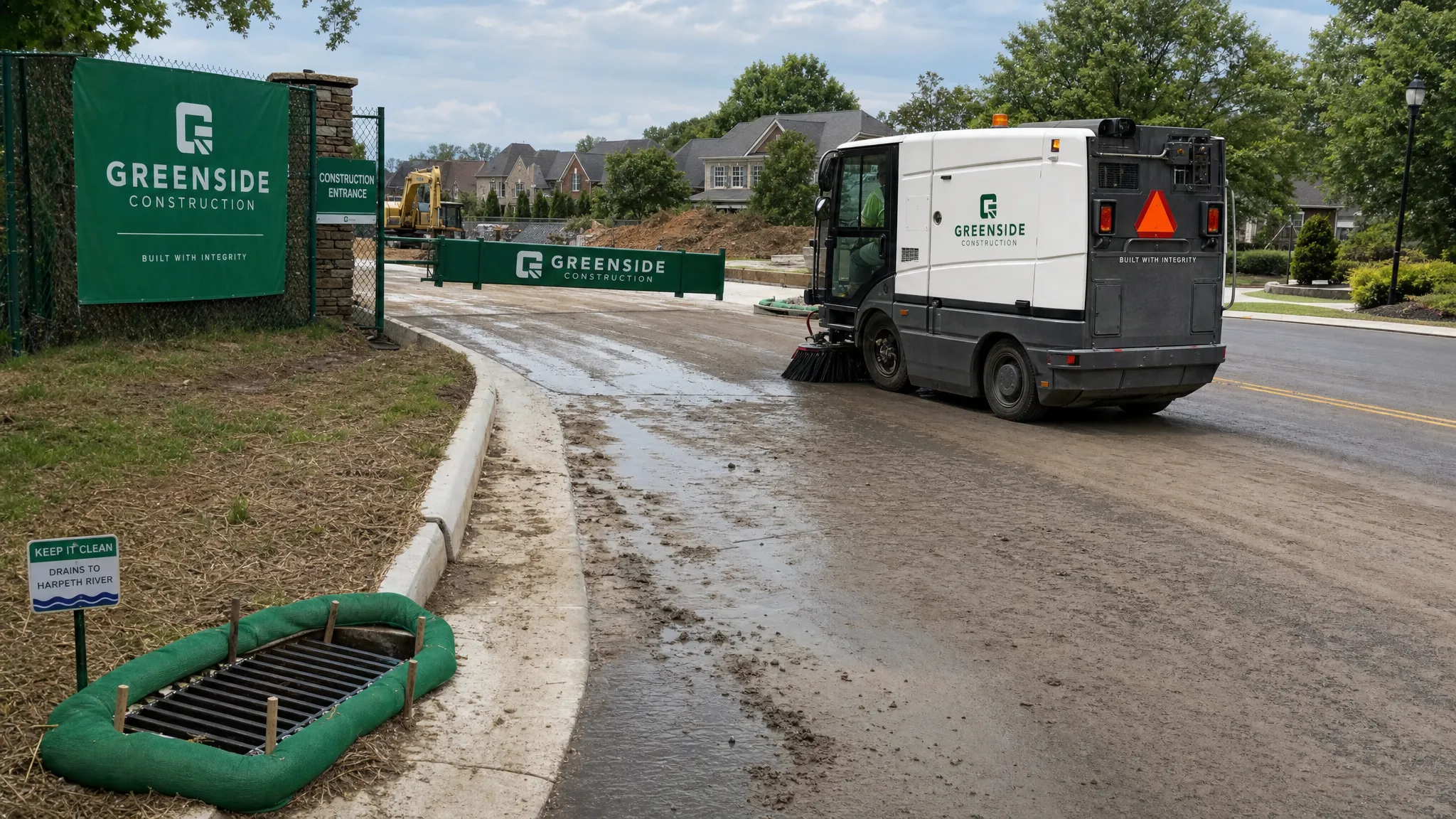
The following areas are seeing more frequent requests for construction cleanup because of growth patterns, traffic pressure, redevelopment, and site conditions. The needs vary by location, but the common thread is the same: debris moves faster when construction activity meets busy roads and active properties.
The urban core remains one of the most demanding cleanup environments in Middle Tennessee. Projects here often have limited staging space, tight delivery windows, heavy pedestrian traffic, and curb lines that are difficult to access during the day.
Cleanup issues usually show up as fine dust on sidewalks, debris near curb returns, metal fragments around loading zones, and sediment collecting around storm drain inlets. Because businesses, residents, tourists, and event traffic share the same streets, small messes become visible quickly.
In these areas, sweeping often has to be timed around traffic patterns, events, lane access, and parking restrictions. A routine sweep may not be enough if a concrete pour, utility cut, or delivery surge creates a same-day problem. For more downtown-specific planning, Reliable Sweepers has a related guide on downtown Nashville sweeping access, timing, and traffic control.
East Nashville and nearby communities continue to see a mix of renovation, infill housing, small commercial work, utility upgrades, and redevelopment. These projects often sit close to established homes, narrow streets, on-street parking, and neighborhood businesses.
That means cleanup is as much about neighbor impact as it is about the job site itself. Mud on a residential street, sawdust at a sidewalk edge, or roofing nails near a parking lane can create complaints fast. The same principle applies across construction trades, from paving and framing to roofing work and roof renovation, where nails, packaging, and loose aggregate can migrate quickly if cleanup is delayed.
For these neighborhoods, a good cleanup plan should focus on public-facing edges. That includes the construction entrance, sidewalks, street parking areas, alley approaches, and curb lines leading to nearby drains.
West Nashville cleanup needs often come from a combination of commercial redevelopment, multifamily projects, roadwork, and neighborhood infill. Bellevue adds another layer with wooded areas, rolling grades, and stormwater flow paths that can move leaves, sediment, and construction material into low points.
The Nations and Charlotte Avenue corridor often require close attention to curb lines, parking edges, and construction access points. These areas can shift quickly from rough construction to tenant-ready space, which makes exterior cleanup important during turnover. Dust that seems minor during buildout can become a customer-facing issue once new businesses open.
For projects moving toward closeout, the best approach is usually phased cleanup rather than waiting for final turnover. A rough sweep after heavy work, a magnet sweep after fastener-heavy activity, and a final detail before striping or tenant opening can reduce rework.
South of Nashville, cleanup needs are heavily influenced by commercial centers, office parks, medical properties, residential developments, and ongoing corridor growth. Franklin and Cool Springs properties often have high expectations for curb appeal, which means construction-related dust and debris can stand out even when it is not severe.
Brentwood and Nolensville projects also tend to involve sensitive access planning. Sites may border schools, offices, neighborhoods, or retail destinations where peak traffic windows matter. Cleanup that blocks access or happens at the wrong time can frustrate tenants and visitors.
In these areas, contractors and property managers should pay attention to haul routes, entrances, parking lot transitions, and any shared access roads. If construction traffic crosses finished pavement, schedule sweeping around the activity rather than after the site already looks neglected.
The southeast side of the region brings a different cleanup profile. Murfreesboro, Smyrna, and La Vergne see a mix of residential expansion, industrial activity, logistics, commercial growth, and roadway work. Larger sites and heavier truck traffic can create widespread dust, mud, loose gravel, and pallet or packaging debris.
Industrial and warehouse-adjacent projects often need more than a visual sweep. Metal fragments, straps, nails, and broken pallet pieces can affect tires, docks, and traffic lanes. Magnet sweeping becomes especially useful when construction overlaps with active operations.
The most common mistake in these corridors is under-scoping the service area. The problem may not stop at the construction entrance. It may continue along the access road, trailer staging area, dock approach, or first several curb returns beyond the site.
East of Nashville, construction cleanup demand is tied to residential growth, retail development, logistics properties, and roadway expansion. Mt. Juliet and Lebanon projects often have larger footprints, longer internal drives, and more truck movement. Donelson and Hermitage add older commercial corridors and redevelopment areas where new work sits beside active businesses.
These sites are prone to dust and mud migration, especially during grading, utility work, and paving prep. When rain hits exposed soil, sediment can move toward curb lines quickly. When dry weather follows, the same material can turn into airborne dust or get tracked into parking lots.
A good plan in these areas includes baseline sweeping plus trigger-based service after rain, heavy hauling, asphalt work, concrete pours, and major deliveries.
North of Nashville, growth along commuter and commercial corridors is increasing cleanup needs for retail centers, neighborhood entrances, road projects, and new residential developments. These areas often involve a mix of public-facing roads and private property responsibilities, so it is important to know where the contractor’s cleanup scope begins and ends.
Sediment at subdivision entrances, loose aggregate near turn lanes, and debris along shared access roads can create friction between builders, HOAs, and property owners. Regular sweeping helps keep those transition points from becoming complaint zones.
For communities with recurring construction activity, a simple baseline schedule can be paired with extra sweeps after weather events or major material deliveries. That approach usually performs better than waiting for a visible mess and then trying to recover the whole area at once.
More construction cleanup does not always mean piles of debris. Often, the signs are smaller and easier to miss until they create a bigger issue.
Common indicators include:
These problems matter because they travel. Material that starts at a job site entrance can move to a public street, then into a curb line, then toward a drain. Dust that starts in a staging area can move into a tenant entrance or parking garage. Loose metal that starts near a dumpster pad can end up in a drive lane.
The earlier teams identify the source and path, the easier cleanup becomes.
Historically, some teams treated cleanup as a final punch item. That approach is risky on active sites around Nashville because exterior conditions can affect inspections, customer perception, tenant readiness, and access long before final turnover.
Earlier cleanup helps managers avoid several common problems. It keeps haul routes safer for drivers and pedestrians. It reduces the chance of sediment reaching stormwater areas. It prevents curb appeal issues at construction-adjacent businesses. It also protects schedules when paving, striping, landscaping, or inspections depend on clean surfaces.
If a project is approaching an inspection, cleanup should be planned several days in advance, not the morning of the visit. Reliable Sweepers’ guide on site cleaning before a city inspection explains how to stage that work so teams are not scrambling at the last minute.
A strong construction cleanup plan does not have to be complicated. It just needs to be specific enough that crews know where to look, when to act, and what finished means.
Start by mapping the site into zones. For most projects, the priority zones are the construction entrance, haul route, curb lines, storm drain areas, dumpster or material staging areas, sidewalks, parking edges, and any public-facing street frontage. These zones should be walked regularly because they are where debris usually escapes first.
Next, set two types of cleanup timing. The first is a baseline cadence, such as a scheduled sweep during active phases. The second is a trigger-based response for events that create unusual debris. Common triggers include rain, grading, heavy trucking, concrete pours, asphalt paving, demolition, high-wind days, and pre-inspection deadlines.
Use the right method for the material. Dry debris should usually be captured before any wet cleaning is considered. Sweeping, pickup, edge detailing, and magnet sweeping help remove material rather than push it around. Wet cleaning may have a place for specific residues, but it should be managed carefully so wash water and sediment do not move into drains.
Finally, document the work. Before-and-after photos, service notes, and marked problem zones give contractors and property managers a clearer record of what was addressed. That documentation can also help when complaints, inspections, or owner questions come up later.
For a deeper construction-focused workflow, see Reliable Sweepers’ construction clean up step-by-step site turnover guide.
In-house crews can handle plenty of small tasks. Picking up packaging, moving scrap to dumpsters, clearing obvious trip hazards, and policing the immediate work zone should be part of daily site discipline.
Professional sweeping becomes more valuable when debris is spread over a larger paved area, when curb lines and drains are involved, when mud track-out reaches public-facing pavement, or when fasteners and metal fragments create tire risk. It also makes sense when your own crews would lose too much productive time trying to clean with tools that are not designed for the job.
Professional services may include construction site sweeping, asphalt paving cleanup, magnet sweeping, dust and mud control, parking lot or garage cleaning, industrial warehouse sweeping, neighborhood or HOA sweeping, municipal sweeping, and emergency response. The right mix depends on the site phase, debris type, access window, and required outcome.
If you are unsure when to schedule sweeping during a project, Reliable Sweepers’ article on the best times for construction sweeping breaks the decision down by phase.
If your property is near construction or preparing for a new project, ask cleanup questions before the first truck arrives. Waiting until debris reaches the curb usually leads to rushed decisions and unclear responsibility.
Useful questions include:
These questions help prevent gaps between the contractor, property manager, HOA, municipality, or landlord. They also make it easier to request an accurate cleanup quote because the scope is based on zones and outcomes rather than vague expectations.
Which areas around Nashville TN need the most construction cleanup right now? Cleanup demand is increasing across downtown Nashville, East Nashville, West Nashville, Franklin, Brentwood, Nolensville, Murfreesboro, Smyrna, La Vergne, Mt. Juliet, Lebanon, Hendersonville, Gallatin, and other growing corridors. The exact need depends on site activity, traffic, weather, and nearby drains or public-facing areas.
How often should an active construction site be swept? Frequency depends on the phase of work and debris load. Many sites benefit from a baseline schedule plus extra sweeps after rain, heavy hauling, paving, concrete pours, demolition, or inspections. High-visibility sites may need more frequent attention.
Is magnet sweeping necessary for every construction site? Not every site needs it every visit, but magnet sweeping is helpful after work that creates nails, screws, wire, and other metal fragments. It is especially valuable near drive lanes, parking areas, loading zones, and active commercial properties.
Can rain make construction cleanup more urgent? Yes. Rain can move sediment and mud from exposed soil to pavement, curb lines, and storm drain areas. After a storm, sites should check entrances, haul routes, low spots, and inlets quickly before material spreads farther.
What should I include when requesting construction cleanup service? Provide the address, site type, debris concerns, access times, priority zones, recent weather or activity, photos if available, and the outcome you need. For example, specify whether the goal is track-out control, pre-inspection cleanup, paving prep, or final turnover.
More construction around Nashville is a sign of regional growth, but it also puts more pressure on streets, lots, curb lines, and stormwater areas. The properties that stay ahead are the ones that treat cleanup as an ongoing site-control measure, not a last-minute fix.
Reliable Sweepers helps contractors, property managers, HOAs, municipalities, and industrial teams across Middle Tennessee keep active sites cleaner, safer, and easier to manage. From construction site sweeping and magnet sweeping to asphalt cleanup, dust and mud control, parking lot cleaning, and emergency response, our team can tailor service to your project phase and site conditions.
If your property is in one of the growing areas around Nashville TN and construction debris is becoming harder to control, contact Reliable Sweepers to build a site-specific cleanup plan that keeps your project moving and your exterior areas presentable.
