Most commercial property teams would love the simplicity of “one call fixes everything.” Fewer vendors to schedule, one invoice to code, one point of accountability when a tenant complains.
But commercial building maintenance is a wide umbrella, and the details matter. In practice, the best results usually come from one maintenance plan and one clear owner, supported by the right mix of specialized services.
This guide will help you decide when one service can realistically handle commercial building maintenance, when it cannot, and how Nashville-area properties can simplify vendor management without creating coverage gaps.
Commercial building maintenance typically spans four categories:
A single provider can be excellent at one or two categories, but it is uncommon for one crew to be equally strong (and properly licensed/insured) across all four.
That is why “one service” needs a clearer definition.
When property managers ask if one service can handle commercial building maintenance, they often mean one of these:
This is the most literal interpretation. It can work for small sites with simple needs, but it is also where expectations most often break.
A single vendor holds the agreement and coordinates subs (janitorial, sweeping, landscaping, pressure washing, etc.). You get one point of contact, but the work is still performed by specialists.
This is the most realistic (and most common) approach. Example: “One exterior maintenance partner owns everything outside the doors,” while another vendor owns janitorial.
For many Nashville commercial sites, option 3 is the sweet spot because exterior cleanliness has unique equipment needs and compliance risks that general cleaners may not cover well.
A single provider can successfully cover commercial maintenance when the scope is:
Exterior cleaning is a good example. The same mobilization, routing, and field process can cover:
If you define outcomes (what “clean” means) and a schedule (baseline plus triggers), one exterior-focused partner can handle a lot of the site’s visible issues consistently.
If your needs are primarily “hardscape and pavement,” consolidating to one exterior partner is often efficient.
For example:
If you want a framework for zoning these areas, Reliable Sweepers has a practical guide on prioritizing high-traffic exterior zones: Commercial building cleaning: high-traffic areas to prioritize.
Even when a vendor says “full-service,” there are common breakpoints.
HVAC, electrical, fire/life safety, elevators, and backflow work often require specialized licensing, inspections, and documentation. Bundling these under a cleaning or sweeping provider is usually not appropriate.
Pressure washing can be effective, but it introduces stormwater considerations. Without containment and recovery, wash water can carry pollutants to storm drains.
If stormwater compliance matters on your site, dry capture first is the safer baseline. Reliable Sweepers summarizes the principle well here: Nashville environmental cleaning: stormwater-friendly cleanup basics.
For broader context, the EPA’s stormwater program is a helpful reference point for why keeping pollutants out of drains matters: EPA stormwater program.
General cleaning vendors often struggle with:
These are exactly the scenarios where services like sweeping and magnet sweeping are designed to perform.
If “one service” means they will respond quickly to track-out, storm debris, or pre-inspection cleanups, you need explicit response windows and a dispatch plan, not a vague promise.
If your goal is simplicity (not just consolidation), a common high-performing structure is:
Then you tie both to the same operating system:
If you are building that system now, this post is a strong complement: Property maintenance and cleaning: one plan, better results.

Use these questions to decide whether consolidation is realistic, and what kind.
If complaints are mostly about:
Then your maintenance problem is largely exterior, and one exterior-focused service can cover a high percentage of what tenants and customers notice first.
If you manage construction-adjacent sites, industrial yards, or properties with sensitive drainage, you likely need stormwater-safe methods and documentation.
A good starting point is adopting dry-first sequencing, especially before any wet cleaning. (Reliable Sweepers also explains the operational sequence angle here: Cleaning and sweeping: the best order for faster turnovers.)
If debris is predictable (daily litter, weekly curb-line buildup), a single schedule may work.
If debris spikes (storms, events, nearby construction, seasonal pollen, leaf drop), you need a plan that includes trigger-based service, not just a fixed cadence.
For a practical Nashville-area frequency baseline, see: Parking lot sweeping services: when and how often to sweep.
Downtown or high-traffic sites may require off-peak windows, staging plans, and clearer communication.
If access is hard, “one service” only works if that partner is genuinely set up for it (equipment fit, scheduling discipline, and field coordination).
Vendor consolidation is only worth it if it reduces:
If consolidation makes any of those worse, it is not simplification, it is risk shifting.
Whether you choose one vendor, a prime contractor, or a two-partner model, your scope should make outcomes measurable.
Instead of “sweep the lot,” define:
Zone-based scoping also makes bid comparisons easier. If you want a bid-clarity approach, this is useful: Commercial cleaning Nashville: how to compare bids by outcomes.
Examples (customize to your site):
Your contract should separate:
You do not need bureaucracy, you need clarity:
This helps you manage performance without hovering.
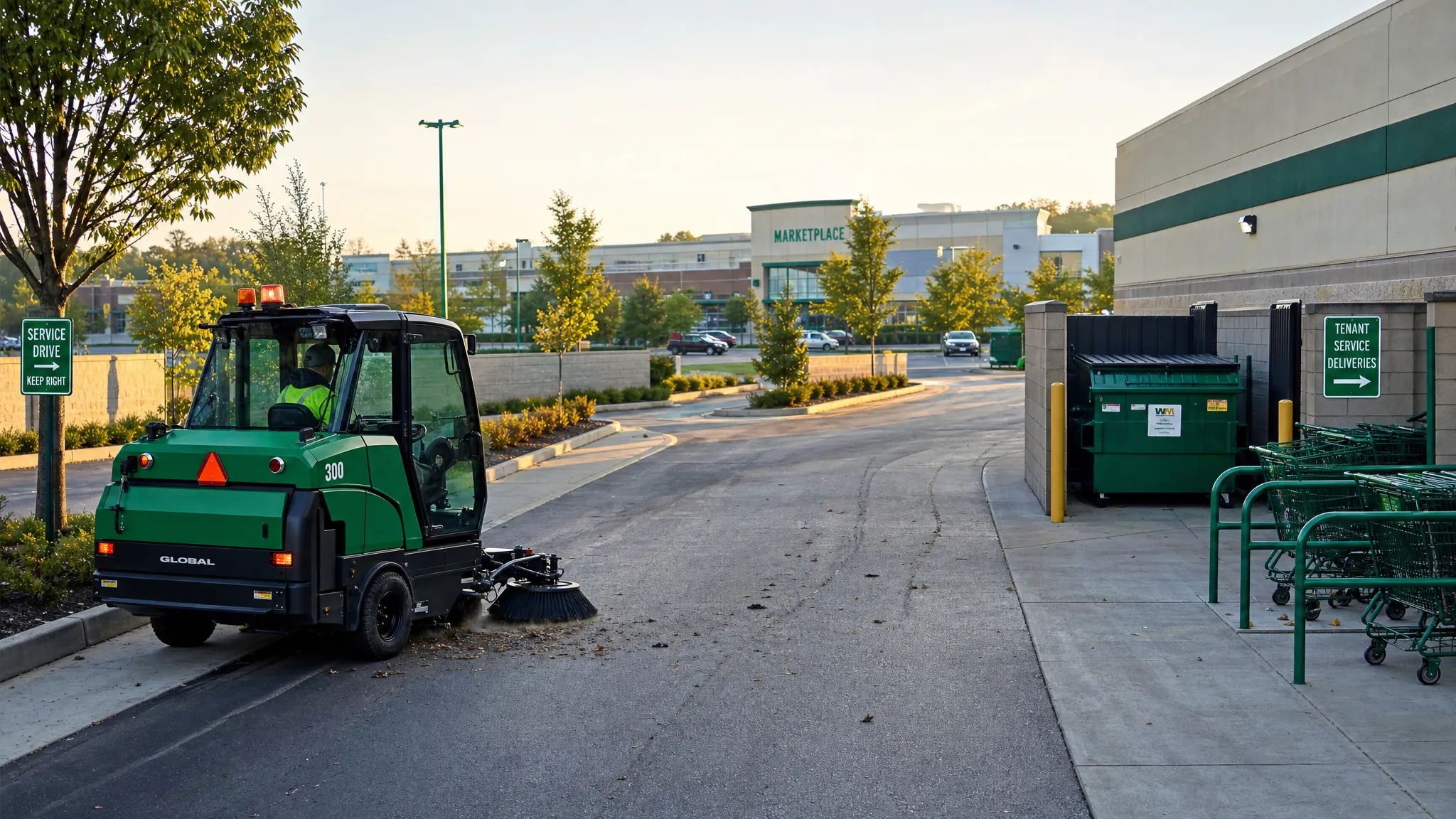
Reliable Sweepers is positioned as an exterior-focused maintenance and street sweeping partner in Nashville and across Middle Tennessee. That makes them a strong candidate for being your “one service” for:
They are not marketed as a replacement for janitorial teams or licensed building system trades, and you should not expect a sweeping partner to own HVAC, electrical, or interior housekeeping.
What you can expect (and what typically creates the most value) is using an exterior partner to remove the debris, dust, and track-out that causes complaints, damages pavement, and increases stormwater risk.
If your goal is to choose the right vendor structure locally, you may also want: How to choose a building maintenance company in Nashville.
Can one company handle both janitorial and sweeping for a commercial building? Sometimes, but it depends on whether they truly have dedicated crews, equipment, and processes for both interior janitorial and exterior sweeping. Many properties get better results with two specialists who coordinate under one plan.
What should be in a commercial building maintenance contract if I want “one service”? A zone map, pass/fail standards, baseline frequency plus trigger events, response times for emergencies, clear inclusions and exclusions, and verification (photos or completion logs).
Is exterior sweeping really “maintenance,” or just cosmetic? It is maintenance. Routine sweeping helps reduce slip and trip risks, protects drainage, supports stormwater best practices, and can extend pavement life by removing abrasive sediment and debris.
How often should a parking lot be swept in Nashville? There is no single number. Many sites use a baseline cadence (weekly or biweekly), then add trigger sweeps after storms, events, nearby construction, or seasonal leaf drop. The right frequency depends on traffic, debris drivers, and visibility.
Do I need stormwater-friendly cleaning methods, or is that only for construction sites? Many commercial properties benefit from stormwater-safe practices, especially around curb lines, inlets, and dumpster pads. Dry capture (sweeping, vacuuming, magnet sweeping) before any wet work is a common best practice.
If you are trying to simplify commercial building maintenance, one of the fastest wins is consolidating exterior cleaning under a single, outcome-based plan.
Reliable Sweepers can help you define exterior zones, set a baseline plus trigger schedule, and choose methods that keep your property clean and compliant across Middle Tennessee. Request a walkthrough and quote at Reliable Sweepers.
Reliable Sweepers provides comprehensive street sweeping and property maintenance services across Middle Tennessee. Whether you're managing a construction site, commercial property, or residential development, our experienced team delivers the professional cleaning solutions you need.