Cleanup is one of the easiest construction costs to underestimate because it rarely sits in one clean bucket. A little labor here, a quick broom pass there, a last-minute sweeper before inspection, and suddenly the “small” cleanup line has become overtime, rework, complaints, blocked access, tire claims, and schedule pressure.
For contractors, the real question is not just, “What does a construction clean up business charge?” The better question is, “What costs will I create if cleanup is late, vague, or scoped too narrowly?”
On active jobsites in Nashville and Middle Tennessee, weather, clay soil, high traffic, paving schedules, and stormwater requirements can turn basic debris control into a project risk. Below are the cleanup costs contractors often miss, plus practical ways to budget and scope the work before it affects turnover.

Construction cleanup often gets treated as a finish-line task, something to handle when the work is “almost done.” That mindset creates cost leakage because debris is generated every day, not just at closeout.
A site may look manageable at 10 a.m., then receive a material delivery, a rainstorm, a concrete pour, and a subcontractor crew change before the end of the day. By the time cleanup becomes obvious, it is no longer a simple sweep. It may require traffic coordination, magnet sweeping, mud control, drain protection, or emergency response.
The other issue is that cleanup costs are frequently spread across several categories:
Because those costs do not always appear on one invoice, they are easy to overlook. A professional cleanup quote may look like an added expense, but a poorly planned cleanup process can cost more through delays and inefficiency.
One of the biggest hidden costs is using skilled trades or high-value field staff for cleanup tasks that could be handled more efficiently by a dedicated crew or sweeping service.
A carpenter, operator, electrician, or site supervisor may be capable of moving trash, clearing curb lines, or sweeping a route, but that does not mean it is the best use of their time. When trade labor gets pulled into repeated cleanup, you pay twice: once for the cleanup itself and again for the work that did not get completed.
This is especially common before inspections, client walks, and turnover milestones. Everyone jumps in to make the site presentable, but the effort is reactive and expensive. A planned cleanup schedule helps preserve production time for the crews that move the project forward.
A cleanup provider’s invoice is only part of the cost. If the site is not accessible when the crew arrives, the job can take longer or require a return trip.
Common access problems include blocked gates, parked equipment along curb lines, material stacks in travel lanes, dumpsters placed where sweepers need to turn, and delivery trucks scheduled during the cleanup window. For parking garages or tight urban sites, access problems can be even more expensive because timing, clearance, and traffic flow matter.
Contractors can reduce this cost by confirming access before service. A simple pre-cleanup check should answer these questions:
A construction clean up business can be more efficient when the site is ready for service. That usually means better results, fewer return trips, and less disruption to the schedule.
Cleaning too early can be just as costly as cleaning too late. If a contractor schedules a final sweep before the last heavy deliveries, landscaping work, paving tie-ins, or punch-list corrections, the same area may need to be cleaned again.
This happens often around turnover. The project team wants the site to look finished, so cleanup starts before the mess-producing work is actually complete. Then a lift tracks dirt across the pavement, a sawcut creates slurry, or a pallet drop spreads packing debris through the parking area.
A better approach is phased cleanup:
For a deeper step-by-step turnover sequence, see Reliable Sweepers’ guide to construction clean up and site turnover.
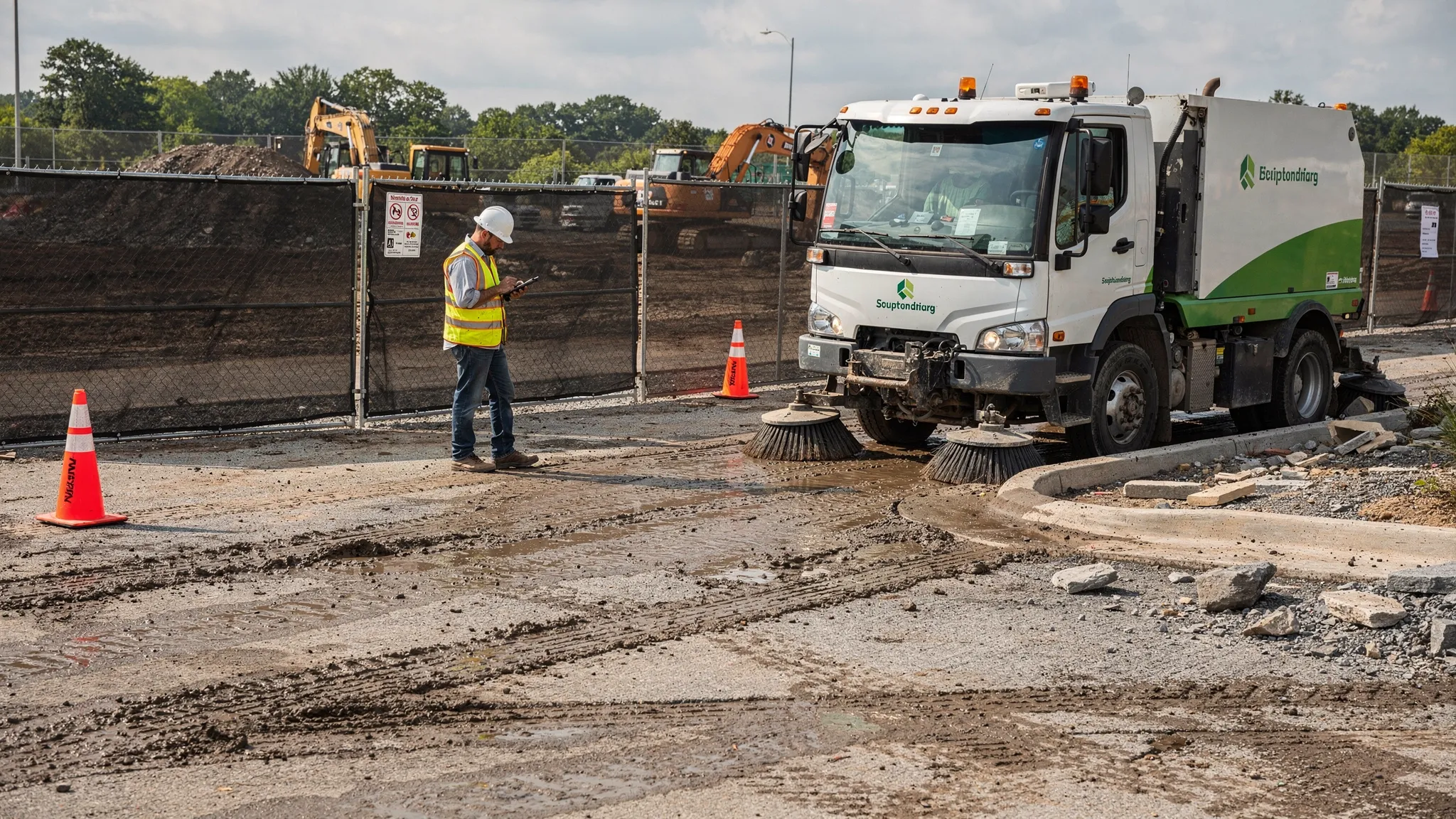
In Middle Tennessee, rain and clay soil can turn a clean exit into a track-out problem quickly. Once mud leaves the site and reaches a public street, the issue becomes more visible and more urgent.
Track-out can trigger complaints from neighbors, property owners, inspectors, or nearby businesses. It can also create slick conditions and push sediment toward curb lines and storm drains. The expensive part is not only the cleanup itself. It is the interruption, the emergency response, and the attention it draws to the jobsite.
Planned sweeping at the site exit, haul route, and public edge is usually cheaper than waiting for a complaint. This is especially important after rain, grading, utility work, concrete pours, and heavy truck traffic.
If track-out has already become urgent, a provider with emergency response capability can help reset the site faster. Reliable Sweepers covers this scenario in its guide to emergency clean up services for job sites.
Debris is cheaper to remove before it reaches drainage structures. Once sediment, leaves, aggregate, trash, or construction debris collects around inlets, curb lines, or low spots, cleanup becomes more detailed and more compliance-sensitive.
The U.S. Environmental Protection Agency notes that construction activity can contribute sediment and pollutants to stormwater if controls are not maintained. Contractors should understand the requirements that apply to their site, including stormwater permits and site-specific plans. The EPA provides additional information on stormwater discharges from construction activities.
Sweeping is not a substitute for a stormwater pollution prevention plan, but it can support site housekeeping by removing material before it enters runoff pathways. The missed cost is often the added labor required after debris has already moved into hard-to-clean areas.
Avoid using water to push debris toward drains. A dry-first approach, including sweeping, curb-line detail work, and targeted pickup, is usually safer and more defensible. For more on this topic, read Reliable Sweepers’ guide to environmental compliance basics for construction cleanup.
Contractors often budget for visible debris, but fine dust can be just as costly. Dust can affect entrances, parking areas, sidewalks, garages, loading zones, and neighboring properties. It can also reduce visibility, create tracking into finished spaces, and make a site look unfinished even after bulky debris has been removed.
Dust problems often appear after sawcutting, grading, concrete work, demolition, drywall deliveries, masonry work, or long dry periods. A quick pass may not be enough if the dust is packed along edges or spread across a wide paved surface.
The hidden cost is repeated spot cleaning. If dust is not captured at the right points in the project, it keeps moving. Vehicles track it, wind redistributes it, and foot traffic carries it into cleaner zones.
A good scope should identify dust-prone areas and specify the right response. That may include mechanical sweeping, vacuum or air-assisted methods where appropriate, dust and mud control, and scheduling around the operations that create the most fines.
Nails, screws, wire, strapping, and other metal fragments are easy to miss during a basic visual cleanup. They collect near dumpsters, material staging areas, framing zones, trailer rows, gates, and routes used by subcontractors.
The cost of missed metal debris can show up as tire repairs, downtime, complaints from tenants or owners, and safety concerns. On active construction sites, a single tire issue can delay a delivery or create unnecessary friction with trades.
Magnet sweeping is a targeted solution for this risk. It does not replace normal sweeping, but it adds a layer of protection where metal fragments are likely. Contractors should consider scheduling magnet sweeping after framing activity, roofing work, demolition, dumpster swaps, and before owner or tenant access begins.
If a quote does not mention metal debris, ask whether magnet sweeping is included, optional, or recommended for specific zones.
Asphalt paving cleanup is another area where contractors underestimate the true cost of being unprepared. Loose aggregate, dirt, milled material, dust, and debris can interfere with paving, sealing, striping, and final presentation.
If pavement is not clean enough when the paving or striping crew is ready, the job can stall. That delay may affect multiple trades, inspections, owner walkthroughs, and opening dates.
The missed cost is usually schedule compression. Crews end up rushing cleanup immediately before another contractor needs the surface. A better plan is to coordinate sweeping around paving milestones, not after the schedule is already tight.
Before paving, sealing, or striping, confirm who owns the cleanup standard. The site should define what “ready” means for travel lanes, parking stalls, curb edges, inlets, tie-ins, and staging areas.
Not all cleanup costs are tied to sweeping time. Disposal, debris type, and material handling can change the scope.
Light litter is different from wet mud. Loose aggregate is different from bulky debris. Metal fragments require different handling than general dust. Some materials may need to be picked up before sweeping is effective. Hazardous materials, regulated waste, or specialty remediation should be handled by qualified providers, not assumed to be part of standard sweeping.
Contractors sometimes miss this because they ask for “cleanup” without describing the debris profile. A clearer request produces a more accurate quote and fewer change orders.
Include the likely debris types when requesting service: mud, dust, gravel, asphalt remnants, nails, pallet debris, leaves, trash, sawcut residue, or post-storm sediment. The more specific the debris profile, the easier it is to match the right equipment and method.
A clean site is valuable, but a clean site with proof is even better. Photos, timestamps, service logs, and zone notes can help show that cleanup was performed and that problem areas were addressed.
This matters before city inspections, owner walkthroughs, tenant access, and closeout. Documentation does not need to be complicated, but skipping it can create avoidable disputes. If a drain inlet was clear before a storm, or a public edge was swept before a delivery, a simple photo can help explain what happened and when.
The Occupational Safety and Health Administration requires construction areas to be kept clear of debris that can create hazards. See OSHA’s construction housekeeping standard at 29 CFR 1926.25. Documentation helps show that housekeeping is being managed as a process, not handled only when someone complains.
Instead of looking only at a per-visit or hourly price, estimate cleanup as a total project cost. The direct vendor price is just one part of the equation.
A more realistic cleanup estimate considers:
This approach shifts cleanup from a reactive expense to a managed control. It also makes bids easier to compare because you are measuring the outcomes you need, not just the cheapest visit.
A vague quote request usually produces a vague scope. To get better pricing and fewer surprises, give the cleanup provider the facts that affect labor, equipment, timing, and risk.
Useful details include the site address, approximate paved area, project phase, access points, preferred service windows, debris types, problem zones, drainage concerns, traffic constraints, and upcoming milestones. If you have a site map or marked-up aerial image, include it.
You should also define the desired result. For example, “remove visible mud track-out from the public road and construction entrance before Monday inspection” is stronger than “clean up site.” Clear outcomes make it easier for the provider to assign the right equipment and for the contractor to verify completion.
For a broader look at what exterior post-construction cleanup may include, see Post Construction Clean Up Services: What’s Included?.
The best way to reduce cleanup cost is not to clean less. It is to clean at the right time, in the right zones, with the right method.
Baseline sweeping keeps routine debris from accumulating. This is especially helpful for construction entrances, haul routes, curb lines, dumpster pads, loading areas, and public-facing edges. A regular rhythm prevents small issues from becoming urgent calls.
Some events should automatically prompt a cleanup check. Rain, heavy deliveries, grading, demolition, paving, concrete work, high wind, failed inlet checks, or upcoming inspections can all justify an extra pass.
Trigger-based scheduling is more cost-effective than guessing. It focuses the budget on the moments when debris risk is highest. Reliable Sweepers covers timing in more detail in Construction Sweeping: Best Times to Sweep During a Project.
Once an area is cleaned for turnover, treat it like a finished surface. Limit access, reroute deliveries, move material staging, and assign responsibility for touch-ups. Otherwise, final cleanup becomes a loop of repeated work.
Every subcontractor should understand housekeeping expectations. That includes where to place scrap, how to manage packaging, which routes to use, and what condition areas should be left in at the end of the shift.
A cleanup vendor can remove debris, but source control keeps the cost from growing.
A low cleanup quote may exclude the details that matter most, such as curb-line work, magnet sweeping, track-out response, after-hours scheduling, or documentation. That does not mean the quote is wrong, but it may not be complete.
When comparing providers, ask what is included, what is excluded, what triggers extra cost, and how completion is verified. The right quote should match the risk profile of the project.
Watch for these warning signs before selecting a provider or approving a scope:
These gaps do not always mean the provider is a bad fit. They do mean the scope needs clarification before the work begins.
Reliable Sweepers supports contractors and property teams across Nashville and Middle Tennessee with exterior-focused cleanup and sweeping services. That includes construction site sweeping, asphalt paving cleanup, parking lot and garage cleaning, industrial warehouse sweeping, neighborhood and municipal sweeping, magnet sweeping, dust and mud control, and emergency response.
For contractors, the value is not just having a sweeper show up. It is having a cleanup plan that fits the phase of work, the debris type, the schedule, and the areas most likely to create delays or complaints.
If your project has public-road exposure, tight turnover dates, frequent mud track-out, metal debris, or inspection pressure, a planned cleanup scope can help keep the site safer, cleaner, and more predictable.
What costs do contractors usually miss when hiring a construction clean up business? Contractors often miss costs tied to access delays, repeated cleaning, trade labor downtime, mud track-out, storm drain detail work, magnet sweeping, disposal assumptions, emergency response, and documentation before inspections or handoff.
Is it cheaper to handle construction cleanup in-house? Sometimes, especially for small daily housekeeping tasks. However, in-house cleanup can become expensive when skilled trades, supervisors, or production crews are pulled away from scheduled work. For larger paved areas, track-out, dust, or metal debris, a professional sweeping provider may be more efficient.
When should construction cleanup be scheduled? Cleanup should be scheduled throughout the project, not only at the end. Use a baseline cadence for routine debris and trigger extra cleanup after rain, heavy deliveries, grading, paving, demolition, concrete work, wind events, inspections, and turnover milestones.
Does sweeping help with stormwater compliance? Sweeping can support stormwater compliance by removing sediment and debris before it reaches curb lines, inlets, and runoff paths. It does not replace the site’s stormwater plan or required controls, but it can be an important housekeeping practice.
What information should I provide for an accurate cleanup quote? Provide the site location, project phase, paved area, debris types, access points, service windows, high-priority zones, drainage concerns, upcoming inspections, and whether services like magnet sweeping, dust control, mud control, or emergency response may be needed.
Cleanup costs are easiest to control before the site is under pressure. If you are budgeting a construction project in Nashville or Middle Tennessee, Reliable Sweepers can help you think through the exterior cleanup scope, identify high-risk zones, and schedule services around the work that creates the most debris.
Visit Reliable Sweepers to request a site-specific cleanup plan or discuss construction sweeping, magnet sweeping, dust and mud control, asphalt paving cleanup, or emergency response for your next project.