
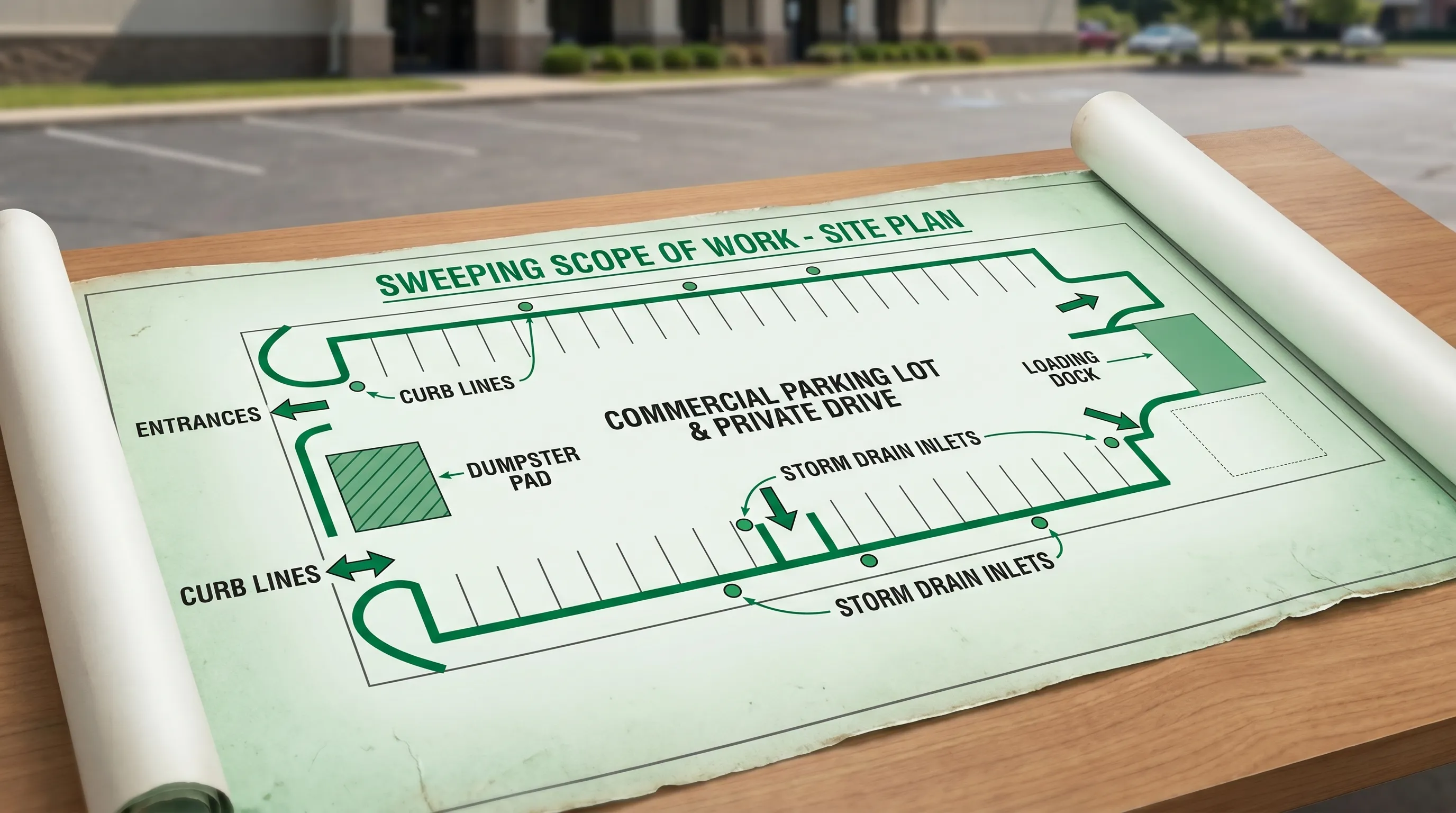
Complaints about “dirty pavement” rarely come from the middle of a wide-open lot. They come from predictable hotspots: entrances, curb lines, dumpster pads, loading docks, and storm drain inlets. The fastest way to reduce those calls (and avoid constant “can you come back?” rework) is to stop buying sweeping as a vague task and start specifying it as a measurable outcome.
This guide shows how to write commercial street sweeping specs that are clear enough for crews to execute and simple enough for property teams to verify.
Most sweeping scopes fail for one of three reasons:
A better spec does two things at once: it tells the sweeper where to focus and tells you how to confirm it’s done.
Start your scope with a plain-English purpose. This keeps everyone aligned when conditions change.
Example objective:
Objective: Maintain a complaint-resistant exterior by removing litter, sediment, and debris from priority zones (entrances, curb lines, drains, and service areas) to support safety, appearance, and stormwater protection.
If stormwater compliance is a driver (common for commercial and industrial properties), align your plan with EPA guidance that emphasizes keeping pollutants out of storm drains and managing runoff impacts under the NPDES/MS4 framework (see EPA stormwater program overview).
Zoning is the single biggest upgrade you can make to a sweeping spec because it mirrors how debris actually behaves.
Use 3 to 5 zones that match how you manage the property:
If you want a quick list of where problems concentrate, this pairs well with Reliable Sweepers’ guide to high-traffic areas to prioritize.
Task lists cause disputes because they describe activity, not results. Swap them for observable outcomes.
Examples of pass/fail language you can use:
Important: avoid specifying outcomes a sweeper cannot reasonably deliver (for example, “remove all stains”). If you may need restoration work, separate it as a different line item (spot cleaning, hot water, wash-water recovery), similar to the “dry first, then wet” sequence explained in Pavement Cleaning: When Power Washing Isn’t Enough.
Sweepers are not interchangeable across debris types. A good spec names what shows up on your site.
Include a short “debris profile” section:
If metal is a known issue (construction nearby, warehouse yards, frequent deliveries), call out magnet sweeping as required in the affected zones.
A fixed schedule alone is why properties look great on Tuesday and terrible by Friday.
Write two scheduling layers:
Baseline cadence: the normal service frequency (weekly, biweekly, monthly, nightly, etc.) by zone priority.
Trigger events: pre-approved reasons to add an extra sweep, so your team is not renegotiating under pressure.
Common trigger language:
For more detail on building schedules that actually hold up in Middle Tennessee conditions, see Parking Lot Sweeping Services: When and How Often to Sweep.
Most complaints are really “detail failures.” Spell out the detail expectations explicitly.
Add a short “Detail Requirements” section like this:
This is also where you can reference your internal walk routine. Reliable Sweepers shares a practical approach in Nashville Road Cleaning: Top Problem Areas and Quick Fixes.
Verification is what ends opinion-based arguments. Keep it simple so it actually happens.
Good verification requirements include:
If you already use outcome-based vendor comparison, align this section with your expectations from Commercial Cleaning Nashville: How to Compare Bids by Outcomes.
This is where many “complaints” are actually scope gaps.
Common exclusions you should clarify:
Then add an escalation sentence:
Escalation: If excluded conditions are found (spill, bulk pile, hazardous material), vendor notifies property contact within X hours with a recommended plan.
That single line prevents a lot of finger-pointing.
Use this as a starting point and adjust your zones and triggers.
Service area: Private drives, parking lanes, curb lines, islands, dumpster/compactor areas, loading dock approaches, storm drain inlet surface areas within the property boundary.
Objective: Maintain complaint-resistant exterior conditions by removing litter, sediment, and debris from priority zones to support safety, appearance, and stormwater protection.
Zones: Contractor shall prioritize Zones A (entrances/high visibility), B (curb lines/edges), C (stormwater points), and D (service areas). Zones are defined on the site map provided by owner/manager.
Standards (pass/fail): After each service, Zones A and D are free of visible litter and loose debris. Curb lines are free of continuous sediment berms and no windrows are left behind. Debris is not blown, rinsed, or pushed into storm drains or landscape beds.
Cadence: Baseline service occurs on the agreed schedule. Additional service may be requested (or pre-authorized, if agreed) after trigger events including storms, leaf drop, dumpster overflow, heavy delivery weeks, tenant events, or inspection windows.
Detail requirements: Curb returns, corners, islands, entrances, and storm drain inlet surface areas receive detail attention. Dumpster pad and loading dock approaches receive focused cleanup.
Verification: Contractor provides before/after photos for Zones A and D and service notes for any blocked or inaccessible areas.
Exclusions: Hazardous material cleanup, liquid spill remediation, concrete slurry, and deep stain removal unless separately authorized.
If you need a construction-adjacent version of this spec, Reliable Sweepers’ construction site cleanup checklist provides a good framework for triggers and missed zones.
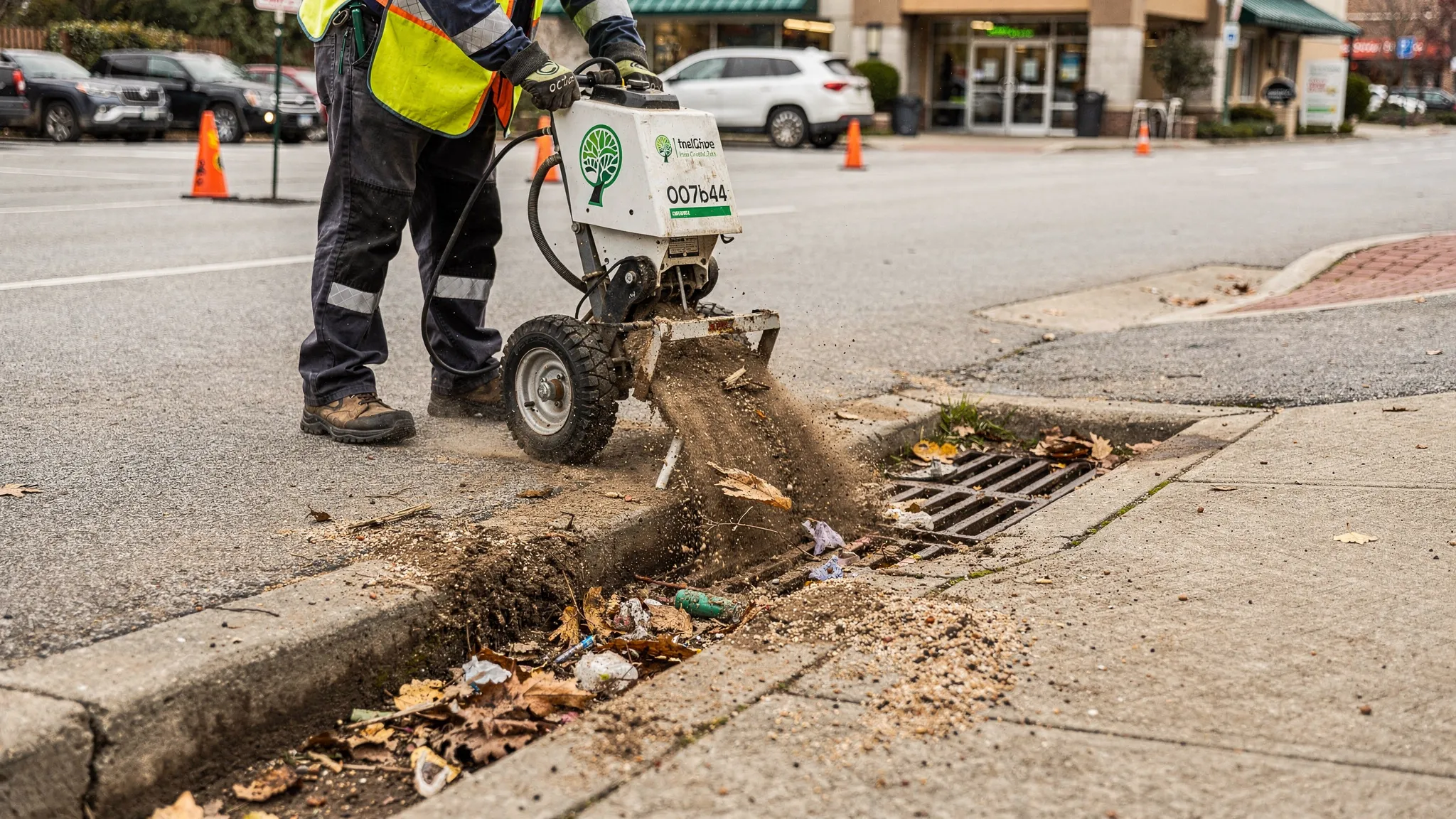
Middle Tennessee storms can move fine sediment fast. The result is usually curb-line berms and clogged low points that look like “the lot is dirty” even after a sweep.
Add a storm trigger and make curb lines and inlets the first priority after rain. For stormwater-friendly practices, EPA guidance consistently emphasizes source control and keeping pollutants out of drainage systems (see EPA stormwater best practices resources).
In spring, pollen and fine dust can create a dingy appearance and slick film in garages and high-traffic areas. Sweeping still helps, but only if your spec requires slower passes and edge detail (not just a quick open-area lap).
Even if your site is not an active job site, nearby construction can create track-out, loose aggregate, and metal fragments that show up at entrances and drive lanes.
If you have recurring nails and sharp debris, require magnet sweeping in the affected zones. Reliable Sweepers covers what commonly gets missed in Construction Site Cleaning: What Gets Missed Most Often.
When you send the same zone map and the same pass/fail standards to every bidder, pricing becomes easier to compare and performance becomes easier to manage.
Ask each vendor to respond to these items in writing:
If you want a deeper procurement lens, see Street Cleaning Companies Nashville: How to Compare Quotes.
What should be included in commercial street sweeping specs? Include zones (entrances, curb lines, dumpster/loading, storm drains), pass/fail standards, baseline frequency plus trigger events, detail expectations, verification, and exclusions.
How do I write a “clean” standard that prevents complaints? Make it observable: “free of visible litter and loose debris,” “no windrows,” “curb lines reset,” and “no debris pushed into drains.” Avoid subjective words like “thorough.”
How often should commercial street sweeping be scheduled? Start with a baseline cadence that matches traffic and debris drivers, then add trigger sweeps after storms, leaf drop, heavy deliveries, events, or inspection windows.
Do I need to mention storm drains in a sweeping scope? Yes. Many complaints and compliance issues start at curb lines and inlets. Your spec should require cleaning around inlets and prohibit pushing debris into drains.
When should magnet sweeping be required? Use it when nails, screws, strapping, or sharp metal fragments are likely, especially near construction-adjacent entrances, loading docks, and industrial yards.
Reliable Sweepers helps property managers, facility teams, and contractors across Middle Tennessee translate “keep it clean” into a zone-based plan with clear outcomes, the right methods (including magnet sweeping and dust or mud control), and verification that reduces callbacks.
If you want, share your site address, operating hours, and your top complaint areas, and we can recommend a practical commercial street sweeping scope and schedule. Learn more at Reliable Sweepers or start with their guide to commercial street sweeping in Nashville.
